On Sunday, August 5th, Music Canada introduced the Three Rs Music Program at the second annual Sawdust City Music Festival in Gravenhurst, Ontario. The new program, which is rescuing gently used instruments, restoring them to fully-functional condition, and then reuniting them with students in publicly funded schools across Ontario, will be fully operational this Fall.
Instruments were collected from artists and concert-goers at Music Canada’s booth in the festival’s Vendor Village at Gull Lake Rotary Park. Among the collected instruments were acoustic and electric guitars, as well as ukulele, fiddle, flute, and snare drum.
The instruments will be restored by Currie’s Music, a local vintage music and repair shop. Once the instruments are fully-functional, they will be made available to publicly funded schools in the Gravenhurst area.
Music Canada would like to thank all the festival attendees who generously donated their instruments. Additional opportunities for instrument donation will be announced soon.
On Saturday May 12th, Music Canada held its third annual international Music Cities Summit The Mastering of a Music City during Canadian Music Week 2018. City professionals, policy-makers, industry executives, and music community members all gathered to discuss topics related to the value of music, its economic impact, and its relationship to innovative city planning and creative entrepreneurship. Click here to view more recaps of panels from the summit.
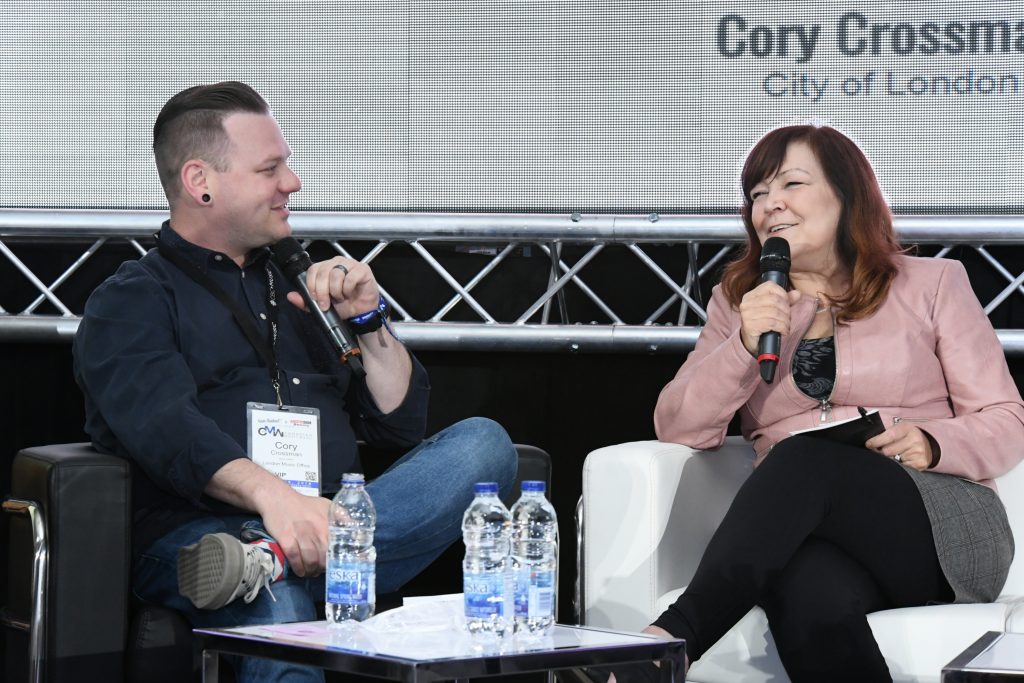
The morning kicked off with a panel discussion between Seattle, WA’s Kate Becker and London, ON’s Cory Crossman, two Music Officers doing exciting work to build up their Music City. The topic centered around exploring their methods of turning music strategies into concrete results, and learning about different approaches they used to address common barriers and problems.
The Music Officers began the conversation discussing the importance of developing a comprehensive music strategy that allows for flexible planning and policy-making. Cory Crossman, London’s Music Industry Development Officer, touched on the importance of branding when developing a profile as a Music City. He highlighted how the city’s path to promoting a ‘rock and roll revitalization’ in London was a key component of their approach and direction.
Kate Becker, Director of Seattle’s Office of Film and Music followed up with touching on some of Seattle’s major music accomplishments. Some of the most notable milestones include an annual City of Music Career Day (now in its seventh year) and the Sea-Tac Airport “Experience the City of Music” initiative, a public-private partnership that features local musicians playing throughout the airport and exciting overhead announcements by renowned Seattle artists, such as Macklemore.
The Music Officers also discussed the importance of ensuring an adherence to safety principles and conditions at music venues or events. Becker reflected on an example in 2015 where the city was faced with a troubling spike in incidences of drug-related issues at Electronic Dance Music (EDM) festivals and clubs. To address this, she implemented an approach that incorporated the input and participation of all the important players in this issue: promoters, venue owners, medics, harm-reduction experts, and more.
In particular, the Office of Film + Music collaborated with the city to host an annual ‘Music Safety Summit’ (now in its 4th year) that serves as a crucial public forum for key actors to work together towards progressive and effective solutions. Becker highlighted how this collaborative approach serves as a model that her office tries to utilize to address different situations that arise.
Becker and Crossman also touched on the critical importance of demonstrating the economic value of music to a city. Crossman credited the London Live Music Census as a major factor in gaining city and political support for the music strategy, and mentioned taking inspiration from Becker’s approach by ensuring that economic impact was measured and incorporated into policy-making. Becker agreed, and discussed how a 2008 economic impact study on Seattle’s music scene was the driving force behind the Office of Film + Music being established.
Prior to taking questions from audience members, Becker and Crossman ended their discussion with a reflection on the importance of audience development, and ensuring that the fans and public are properly engaged and connected.
Watch a video of the full discussion below, and stay tuned next week for a recap of another exciting panel.
On Wednesday, March 7 at the Five Points Theatre (formerly the Mady Centre for the Performing Arts) in downtown Barrie, Ontario, representatives from CultureCap and Nordicity unveiled the brand-new Barrie-Simcoe County Music Strategy. The Strategy was informed by a recent survey that garnered more than 270 responses from community members across Simcoe County, as well as consultations with local artists, labels, venues, tourism officials and municipal staff from local governments.
Combining various independent data sources, an inventory and map of musical resources in Simcoe County was constructed. 256 music businesses were identified in the County, mostly concentrated in five clusters: Barrie, Midland, Orillia, Wasaga Beach and Collingwood. As such, the Strategy sets a bold vision that “Simcoe County will be nationally-recognized as a constellation of distinct local music scenes committed to artistic ambition” within three years, where its distinct scenes shine brighter when united.
To reach this goal by 2021, the Strategy proposes the following mission for Simcoe County governments and the music community:
Build the foundation to support and advocate for music
Connect people in the music community, both internally and externally
Streamline regulatory pathways
Promote accessibility to reasonably-priced rehearsal spaces
Tell stories and build an identity to bolster a local star system
42% of the financial activity of music businesses in the County is generated in the summer season, and the Strategy suggests creating a cluster in the live music sector with festivals, venues and artists, and also framing Simcoe County as a place that “lets festivals happen.”
To guide the execution of the Strategy, a collaborative organizational structure in which MusicCO acts as a coordinating body of several Local Municipal Music Committees, beginning with Barrie, Orillia and Collingwood, is proposed.
Stay tuned for updates from the project’s partners in the near future as the results of the study and the full Barrie-Simcoe County Music Strategy are officially released.
Below are introductory remarks delivered by Music Canada’s President and CEO, Graham Henderson, at the Provincial Arts Education Roundtable hosted by the Ontario Ministry of Education and Ministry of Tourism, Culture and Sport on October 16, 2017.
It sometimes feels today as though the liberal arts and the humanities are under siege. Right across the United States, Republican governors are rolling back support for state universities that offer liberal arts education. And we must be vigilant – because if it can happen there, it can happen here.
Culture and the arts are worth fighting for. The poet Percy Bysshe Shelley believed that the arts can reform the world. He developed a theory of the imagination. He believed that what he called the “cultivated imagination” can see the world differently – through a lens of love and empathy. And how do you get one of those “cultivated imaginations”? Well through exposure to culture.
Now, it might be said that we live in a technology obsessed world. And you, know, Percy’s wife, Mary had something to say about that. She wrote Frankenstein, a book whose central message seems to be that the unmediated, unexamined introduction of technology into our lives is fraught with risk and danger. It can, not always, but it can create monsters.
Poets today continue to operate in this tradition. If you don’t know the Texan poet and performance artist Arielle Cottingham, you should. Cottingham, now living in Melbourne, won the 2016 edition of the Australian Poetry Slam with an electrifying performance. She was recently interviewed for the magazine ArtsHub. In an article meaningfully entitled, “Why We Need Poets More Than Ever Before”, Cottingham cited Shelley as an inspiration for her work and pointed to his famous comment in A Defense of Poetry: Poets are the unacknowledged legislators of the world.
Shelley used the term “legislator” in a special sense. Not as someone who “makes laws” but as someone who is a “representative” of the people. In this sense creators must be thought of as the voice of the people; as a critical foundation of our society and of our democracy. They offer insights into our world and provide potential solutions – they underpin our future.
Cottingham agrees and explained it this way:
[Shelley] argues that poets are the moral barometers of their times and circumstances – and look at the well-known poets today. Bob Dylan is lauded as the voice of a generation. Maya Angelou elevated the voice of the black woman to an unprecedented visibility. Gil Scott Heron wrote a single line of poetry so prescient that it became more famous than he himself did – “The revolution will not be televised.” To quote Miles Merrill, “poets are more honest than politicians.”
A liberal arts education and an education in the humanities – STEM blended into STEAM – is therefore essential to a healthy society and one that is governed by empathy and love.
The study shows that a vibrant arts and culture scene, including live music events, can be a major driver in attracting and retaining employees, and is based on a survey of 500 skilled workers, and 508 businesses in Ontario. While businesses recognize the magnetic nature of arts and culture to skilled workers, the study concludes that they can do more to support local arts communities. According to the study, only 25% of businesses in Ontario make financial contributions to arts and/or cultural organizations in their community.
“The study’s bottom line is that businesses need to make arts and culture more of a priority,” said Nichole Anderson, President & CEO of Business for the Arts. “Our culture for competitiveness study confirms that skilled workers seek out vibrant arts and culture hubs when making job decisions, but businesses who could benefit from the magnetic effect of culture are not investing in their arts and culture ecosystem.”
The study includes the following findings:
60 per cent of businesses said that there are usually more qualified and attractive potential employees in communities with a thriving arts scene
64 per cent of businesses said that a thriving arts and culture scene is something that would make it easier to attract top talent to their community
49 per cent of skilled workers go to arts and cultural festivals two to four times per year
Just over half of skilled workers said that a healthy vibrant arts and culture community has influenced their choice regarding which city they would want to work in
Skilled workers in Toronto tend to value arts and culture more than those living elsewhere (85 per cent compared to 73 per cent)
75 per cent of skilled workers agreed that government support for the arts makes a more livable community
The results of this new study echo parts of Music Canada and IFPI’s Mastering of a Music City report. One finding in the report was that music branding undertaken by a city adds a “cool” factor, that can attract and retain investment and talent. In Berlin, the intermingling of music and tech businesses has demonstrated that a successful music economy can attract and retain talent in other industries as well.
The Mastering of a Music City looks to global cities where an understanding exists that arts, culture, and music specifically, help to attract talent and business. Fredrik Sandsten, Event Manager Music at the public tourism agency in Sweden says of Gothenburg, “We have a very industrial city with huge industrial companies. They want culture and music to flourish because they see the link to attracting young workers to their companies.”
Ontario is home to many communities with vibrant arts scenes, where music, in addition to attracting businesses and talent, contributes directly to the economy. Music Canada’s report Live Music Measures Up: An Economic Impact Analysis of Live Music in Ontario identified that live music companies generated $628 million from live music activities in 2013, and brought a total impact of 10,500 jobs to the province.
Music Canada welcomes the results of Business for the Arts’ new study, and encourages Canadian businesses to support their local arts communities, including local music scenes, so that those communities and businesses continue to flourish together.

Music Canada