Music Canada

Gold & Platinum

Join Mailing List

Music Canada

Gold & Platinum

 Music Canada

News

view

PHOTOS: Jesse Cook Performs In The Courtyard

Canadian nuevo flamenco guitarist Jesse Cook performed a rare unplugged set during a visit to the Music Canada office Tuesday. Cook’s new album One World displays the JUNO-award winning and Platinum-certified artist further connecting styles and themes of music from across the globe centered around his unique style of guitar playing. One World also finds Cook experimenting with new electronic and metallic sounds, which he credits his two young children as influences for the new direction. Fans of all ages and genres should catch Cook’s brilliant guitar playing when he tours across Canada this fall!
jessecook1 jessecook2 jessecook3 jessecook4


Comments
view

It’s Official! Copyright in Canada Extended to 70 Years for Sound Recordings

Music Canada is pleased to announce that the Budget, the Economic Action Plan 2015, has received royal assent and is now law. We applaud the Government of Canada for the inclusion of copyright term extension. With the passing of this bill, the term of copyright for sound recordings has been extended from 50 to 70 years. This brings Canada’s copyright term for sound recordings in line with the international standard, protecting works of vital importance to many Canadian artists.

A copyright term of 70 years will mean that artists and other rights holders retain control of their sound recordings and can profit from them into their elder years. Without term extension for sound recordings, the early works of Leonard Cohen, Neil Young, Gordon Lightfoot, Joni Mitchell, and Anne Murray would have been in public domain over the next five years.

“I’m still releasing albums but my fans love my older songs. Thanks to the federal government for the recent legislation. Its passage will make sure the sun doesn’t go down on my early songs,” says Gordon Lightfoot.

For younger artists, additional profits derived by rights holders from older recordings will be reinvested in developing artists. The music industry is second to none in terms of reinvestment in new talent, with over 28% of revenue reinvested in 2014.

“In extending the term of copyright in recorded music, Prime Minister Harper and the Government of Canada have demonstrated a real understanding of music’s importance to the Canadian economy. Thank you. We are thrilled to see Canada brought in line with the international standard of 70 years.” says Graham Henderson, President of Music Canada.

Comments
view

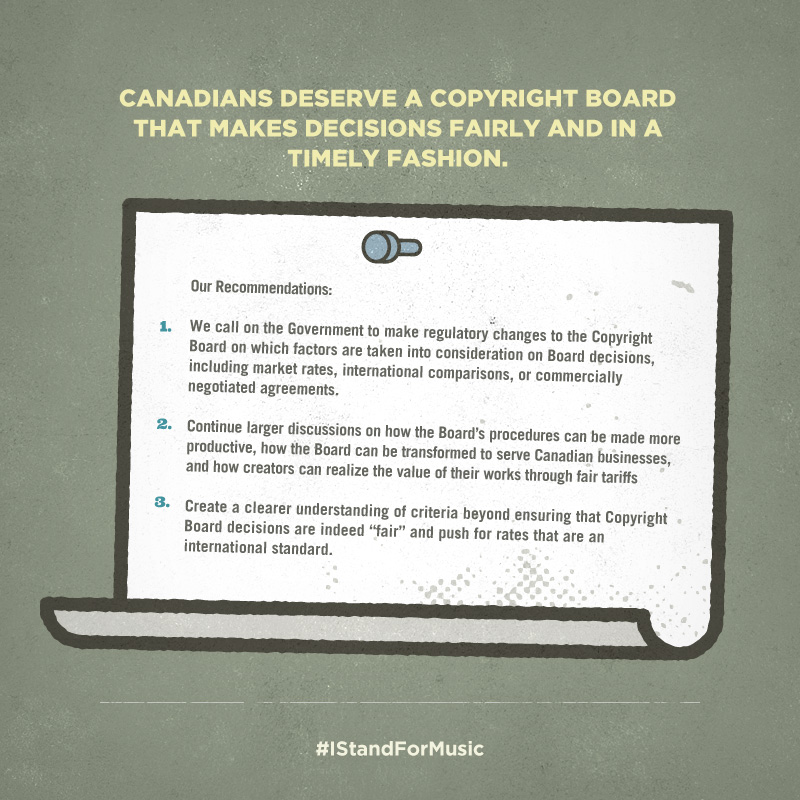
8 Days of Tariff 8: Canadians deserve a Copyright Board that make decisions fairly and in a timely fashion

As we wrap up our 8 Days of Tariff 8 campaign, we call for reform of the Copyright Board. We are asking the Government to make regulatory changes that determine which factors are taken into consideration on Board decisions, including market rates, international comparisons, or commercially negotiated agreements.

t8-09

Our Recommendations:

  1. We call on the Government to make regulatory changes to the Copyright Board on which factors are taken into consideration on Board decisions, including market rates, international comparisons, or commercially negotiated agreements.
  2. Continue larger discussions on how the Board’s procedures can be made more productive, how the Board can be transformed to serve Canadian businesses, and how creators can realize the value of their works through fair tariffs
  3. Create a clearer understanding of criteria beyond ensuring that Copyright Board decisions are indeed “fair” and push for rates that are an international standard.


Thank you for your support over the last 8 days. The fight’s not over. We urge you to use the tool below to send an email to newly-appointed Copyright Board chair Justice Robert A. Blair, urging him to facilitate the prosperity of Canadian cultural businesses rather than impede it by recognizing the value of the Canadian music industry for all Canadians.

Comments
view

Sam Hunt Receives Gold Plaque For Debut Album

samhunt

Country newcomer Sam Hunt was in Toronto last week for an opening slot on multi-Platinum superstars Lady Antebellum’s summer tour with Hunter Hayes at the Molson Canadian Ampitheatre. During his visit, Universal Music Canada presented Hunt with a custom Gold plaque commemorating the sales achievements of his debut album Montevallo and single “Leave The Night On”. His latest single “Take Your Time” was also included on the plaque for it’s recent Platinum certification.


Comments
view

Graham Henderson on Taylor Swift, Apple, and the Canadian music industry

Music Canada applauds Apple Music’s decision to reconsider its earlier plans to not pay artists during its three-month free trial period, and we commend Taylor Swift for standing up for artists. In an open letter to Apple that she released on June 22, she writes that she wanted to speak up not for herself, but for “the new artist or band that has just released their first single and will not be paid for its success. This is about the young songwriter who just got his or her first cut and thought that the royalties from that would get them out of debt. This is about the producer who works tirelessly to innovate and create, just like the innovators and creators at Apple are pioneering in their field… but will not get paid for a quarter of a year’s worth of plays on his or her songs.”

The decision comes after major backlash over the deal both in Canada and abroad, with many independent labels and advocacy groups speaking against Apple.

Yesterday, Music Canada President Graham Henderson appeared on BNN, the Sandie Ronaldo show and CTV’s national news to discuss how this decision will impact Canadian consumers, artists, and the digital music industry as a whole.

Apple’s ‘Swift’ action a step towards bringing back middle class musicians
BNN, June 22 2015


Comments
view

8 Days of Tariff 8: Tariff 8 is a Lose/Lose/Lose

We believe the Tariff 8 decision set a dangerous precedent in Canada for streaming rates on music streaming services.

t8-06

There are three ways in which this decision negatively impacts the Canadian music industry:

  • Tariff 8 is bad for Canadian artists, who receive 10% of the streaming royalties from semi-interactive services as their American counterparts. This means that Canadian artists are paid 90% less than what other artists on similar services outside of the country are paid.
  • Tariff 8 is bad for international artists, who receive less royalties when their work is played on Canadian semi-interactive streaming services. This could lead to international artists refusing to have their music used on these services, potentially limiting content to Canadians.
  • Tariff 8 is bad for the economy because it shows just how unpredictable the Copyright Board is. It created a regulatory precedent that ignores the reality of the marketplace and will continue to harm the business climate and create a market of uncertainty. This may dissuade new services from entering the Canadian market, which means less choice for consumers.

Stand with us and join the conversation at #IStandForMusic.

Comments
view

City of London seeking applications for Music Industry Development Officer position

The City of London has issued a job posting for a Music Industry Development Officer, working in the City Manager’s Community & Economic Innovation division.

“The Music Industry Development Officer is responsible for working with the Music Industry Resource Committee composed of representatives from: the City of London, Tourism London Inc. and the London Arts Council on implementation of the London Music Strategy,” reads the position’s Summary of Duties. “Specifically, the Music Industry Development Officer works towards advancing the eleven (11) Key Priorities from the London Music Strategy. The advancing of each of these Key Priorities may involve several organizations, including many community partners.”

Tourism London shared news of the job position this past weekend on Twitter:

The position marks another step forward in the London’s Music Strategy, which was developed by London’s Music Industry Development Task Force in 2014. Earlier this month, the strategy was advanced with the announcement that the iconic downtown building at 182 Dundas St., home to Nash Jewellers for nearly a century, would be repurposed to accelerate London’s music sector. The project, dubbed The London Music Division, is proposed to act as a collective centralized resource for the commercial music sector, featuring a Music Incubator, the London Music Hall of Fame, and a future Music Office.

If you are interested in the Music Industry Development Officer position or know someone else who might be interested, please visit https://careers2.hiredesk.net/viewjobs/JobDetail.asp?Comp=CityofLondon&sPERS_ID=&TP_ID=1&JB_ID=&PROJ_ID={C346BDCC-9CA8-4708-9456-9846226C9DF3}&LAN=en-US&BackUrl=ViewJobs/Default.asp for more information.

Comments
view

8 Days of Tariff 8: The Copyright Board doesn’t value musicians

Can you imagine being in a profession where your U.S. counterpart made 90% more than what you make for the same job? With Tariff 8, the Copyright Board of Canada decided that professional musicians should be paid 90% less for certain types of music streaming.

t8-07

Some people may argue that Tariff 8 isn’t an artist’s only source of income. But the reality is that for these types of services (CBC Music, Stingray, Songza, etc.), Tariff 8 royalties are the only guaranteed source of income for a performer.  Artists deserve to be fairly compensated for their music. The Tariff 8 decision sends a message that music is not valued as a profession here, and this message is completely inconsistent with Canadian values.

In last year’s The Rambler by Graham Henderson: Tariff 8 decision establishes “10% of Nothing Rates”, Music Canada President poses the rhetorical question:  “Do Canadian plumbers get paid wages equivalent to 10% of American plumbers? Teachers? Auto workers? Farmers? Who? What profession receives compensation in Canada for their labour that is equal to 10% of the wages paid across the border?”

If you think Canadian artists should be fairly compensated, share this image with the #IStandForMusic tag.

Comments
view

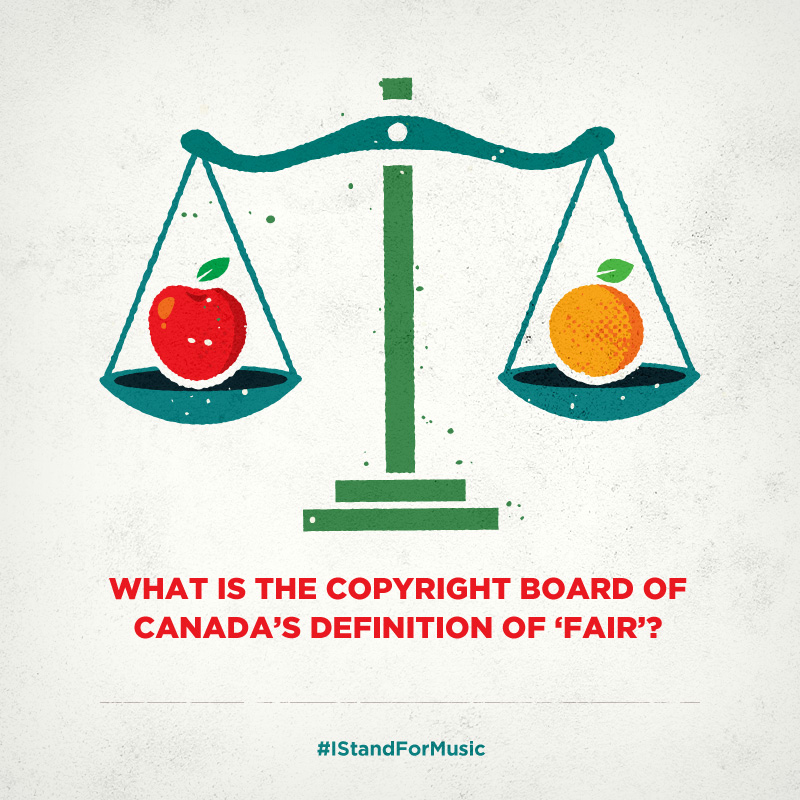
8 Days of Tariff 8: What is the Copyright Board of Canada’s definition of ‘fair’?

The Copyright Board claims to operate on a “fairness principle” but has made a decision that is inherently unfair to Canadian artists, and does not take into account the differences between web and terrestrial radio, on which they based the Tariff 8 rates. This decision has created a regulatory precedent and decision that ignores the reality of the marketplace and will continue to harm the business climate and create a market uncertainty.

t8-08

We believe that if the Copyright Board of Canada wanted to embody a ‘fair’ approach, it would not have discarded existing market rates at which digital music service providers had been operating in Canada. In fact, Tariff 8 discarded years of agreements freely negotiated between digital music service providers and the music industry, setting the rates for webstreaming in Canada at 10% of the rates that the same services pay in the United States and many other countries.


Help raise awareness about the disastrous effects of the Copyright Board of Canada’s Tariff 8 decision by retweeting the image below:


Join I Stand For Music on Facebook Share The Campaign

Comments
view

8 Days of Tariff 8: Making Cents of Tariff 8

When you break Tariff 8 down into real numbers, it’s terrible for musicians. On the occasion of #ThrowBackThursday, we look back at our attempt to make cents of Tariff 8. Last year, we used the Barenaked Ladies classic “If I Had a Million Dollars” to show just how many streams they would need to buy the items in the song at the rate determined by Tariff 8. As you can see, it’s pretty abysmal.

t8-05

Here’s how many plays an artist would need to buy some of the other items mentioned in the song:

“If I had a million dollars… ” / 1 million dollars = 9.8 billion plays

“I’d buy you a house…” / Average price of a single home in Canada: $413,215 = More than 4 billion plays

“I’d buy you furniture for your house, (Maybe a nice chesterfield or an ottoman)” / Nice sofa = 16 million plays, matching ottoman = almost 5 million plays

“I’d buy you a fur coat (but not a real fur coat that’s cruel)” / Faux Fur Coat = 17 million plays

“I’d buy you an exotic pet (Like a llama or an emu)” / Llama = almost 3 million plays

“We wouldn’t have to eat Kraft Dinner. (But we would eat Kraft Dinner. Of course we would, we’d just eat more.)” / Kraft Dinner = 9216 plays for a box of KD

“I’d buy you a green dress (but not a real green dress, that’s cruel)” / A real green dress (that’s cruel!) = almost 16 million plays

“I’d buy you some art (a Picasso or a Garfunkel)” / Picasso recently sold at Sotheby’s for $6.5 million CAD = almost 64 billion plays

 “I’d buy you a monkey (haven’t you always wanted a monkey?)” / (It is illegal to own a monkey in Toronto.)

 “I’d be rich.” / With royalties from the Tariff 8 decision, you would not be rich.

How does Tariff 8 affect you? Use our Tariff 8 Royalty Calculator to learn how much the Copyright Board of Canada thinks you deserve to be paid for your music.


Help raise awareness about the disastrous effects of the Copyright Board of Canada’s Tariff 8 decision by retweeting the image below:

Join I Stand For Music on Facebook Share The Campaign

Comments

This website made possible with the support of the Ontario Media Development Corporation.