On Thursday, November 30, The Come Up Show will celebrate their 10th anniversary at Adelaide Hall with a stellar lineup headlined by Toronto R&B singer 11:11, featuring special guests Adria Kain, Kennedy Rd, and Emanuel.
The Come Up Show has supported and promoted Canadian independent hip hop since 2007, when Adulis “Chedo” Mokanan began broadcasting live on 94.9FM CHRW in London, ON.
“When I started The Come Up Show in 2007, it was out of frustration that there was no good hip-hop music being played on the radio in my city,” says Chedo, who is also the former Music Programmer for Toronto’s Manifesto Festival. “As soon as I started the show, I was blown away by the amount of talent I was discovering in the Canadian Indie scene. Who is supporting these artists? What outlets are pushing them? Why is nobody doing anything? Nobody really cared about new Canadian or Indie artists unless you were already established.”
Now based in Toronto, The Come Up Show is a go-to destination for concerts, interviews, and commentary on hip-hop culture in Canada and abroad. A new episode of The Come Up Show podcast is available every Wednesday, which features interviews with some of hip hop’s biggest names and rising stars, including recent guests like Majid Jordan, Wyclef Jean, Clairmont The Second, a l l i e, Khalid and more.
Click here to buy tickets to The Come Up Show’s 10 Year Anniversary concert, and listen to a playlist via Spotify and Apple Music with songs by all the artists below.
Mulholland’s keynote topic was “Redefining Success in a Digital Marketplace.” Her speech highlighted the challenges for artists working in today’s digital age and proposed solutions to help create a more balanced music ecosystem in which creators can earn a living.
Mulholland’s speech was followed by a panel discussion with representatives from different cultural industries, who discussed how the digital marketplace has affected their industries and their individual careers. The panel, which was moderated by Vassy Kapelos, Global National’s Ottawa Bureau Chief and host of The West Block, included:
Video of the keynote and panel is now available online, and embedded below. The event was attended by many artists and Ottawa music industry members, as well as MPs Gord Brown, Julie Dabrusin, and Pierre Nantel, who are members of the All Party Music Caucus. A selection of photos and social media posts from event is included at the end of this post.
Mulholland began by observing “an extremely important anniversary in the lives of all creators” – the date the Copyright Modernization Act came into force, just over 5 years ago. Although Mulholland referred to the Act as a “landmark”, she acknowledged that it wasn’t perfect and “probably created as many problems for creators as it solved.” Fortunately, the legislation included a specific provision that mandates a review of the Act, 5 years to the day that it came into force. Unfortunately, that date passed two weeks ago, and creators are still waiting for the review to begin.
“I find this disappointing,” said Mulholland. She then spoke about her path to advocacy, referencing two conversations with Heritage Minister Mélanie Joly, who told her “artists need to speak up” in the government’s “Canadian Content in a Digital World” consultations. Those conversations led directly to the founding of Focus On Creators, a coalition of more than 3,500 Canadian creators asking the government to put creators at the heart of future policy. Speaking of her previous speech at the Economic Club, Mulholland thanked MP Julie Dabrusin for raising some of the issues her keynote addressed in a meeting of the Standing Committee on Canadian Heritage. After noting that she is aware of the government’s increased funding for grants and export, Mulholland reiterated her call for a market that properly values their work: “the main message of creators, and what we’re trying to say, is that we want a functioning marketplace right here at home. We are here, and we’re speaking up. We’d love to be heard.”
After a brief recap of her artistic bona fides – violin training since age 4; studying Opera Performance at Western and McGill Universities; founding a record label and festival; performing as a member of Harrow Fair, Great Lake Swimmers, and performing on hundreds of recordings by artists such as Cowboy Junkies, Donovan Woods and Rose Cousins, as well as film & television work including CBC’s Republic of Doyle and the film Maudie; a member of the Soulpepper Theatre Company and the Board of Governors of Massey/Roy Thomson Hall – Mulholland acknowledged that she has a serious problem: “My problem is that because of this Broken Promise of a Golden Age, I’m barely able to make a living.”
Mulholland explained that when sharing her concerns with policymakers, the response that she is often given “is that creators are asking for the clock to be turned back… but that is not what we want. However, we do need to look back at the policies and promises that were made in the late 90s, and recognize that times have changed. My MySpace page doesn’t work anymore. If anything, we’d like to turn the clock forward and rethink some of these ideas and assumptions that have turned out to be false and predictions that have sadly not come to pass.”
After outlining some of the challenges that today’s artists face, including financial hardship and an increasing number of middlemen involved in distributing her music and collecting revenues, Mulholland pivoted from the solution often offered to creators expressing their concerns (“adapt”) to a key theme of her speech: Accountability.
“Let’s look at the current situation and who is accountable for the devaluation to which we are forced to adapt,” said Mulholland. “Accountability means acknowledging value and compensating for it.”
Mulholland called for accountability from digital services like YouTube, and showed why the often-proposed solution of live touring is not a panacea, or even feasible for many artists. Turning to solutions, Mulholland referred a pamphlet distributed with advocacy infographics, which are available on her website. Explaining that we all have a role to play in improving the music ecosystem, Mulholland identified steps that artists, consumers, industry members, and government can take to help ameliorate the current situation.
Mulholland urged the government to end tech company safe harbours: “The European Commission has now acknowledged that the market isn’t functioning properly, and they have identified and accepted the problem as the unintended Value Gap, and agreed that legal clarification is needed. Can we follow suit?”
She also called on the government to end other industry cross-subsidies, such as the Radio Royalty Exemption, “an industry cross-subsidy given to every commercial radio station in Canada, exempting them from paying more than $100 in royalties to artists and record labels on their first $1.25 million in advertising revenue,” said Mulholland. “The Exemption was introduced as a political compromise in the 1997 amendments to the Copyright Act, but it is now outdated and unjustified – if it ever was justified. It is really not right that artists and labels continue to subsidize these large media companies. I am subsidizing Bell.”
Mulholland then highlighted that due to the definition of sound recordings in the Copyright Act, recorded music is actually not considered a ‘sound recording’ (and thus not entitled to royalties) when it is included in a TV or film soundtrack. “This affects me greatly,” said Mulholland, “because for example, even though I played on almost every episode of CBC’s Republic of Doyle, which is now syndicated worldwide, I only received the one-time union rate I got per session, which was around $280, while the composer collects residuals every time that show airs. 44 countries around the world – the UK, France and Australia among them – afford performers and record labels the right to receive public performance royalties when their sound recordings are used as a part of a soundtrack in TV and film.”
Mulholland closed by stating “a culture of permission-less innovation” is what led to the current situation. With that, she referenced another anniversary – the two hundredth anniversary of Frankenstein. “Mary Shelley wrote this classic after witnessing the disastrous consequences of her industrial revolution,” said Mulholland. “The moral of her story is that monsters are created when the only question being asked is ‘Can I?’
We know what’s it has done to the livelihood of creators – it’s produced the Value Gap, and that is our monster.”
"The gov't needs to redefine who it is they're protecting—if artists need to adapt, then so do the policies that protect us" says @miramulhollandpic.twitter.com/458BYBjjhS
Thanks for coming everyone! Now, let’s get to work. Government was required to appoint or designate a committee two weeks ago. This did not happen. Creators are in crisis. That was @miramulholland’s message. Let’s act with urgency. https://t.co/KkTJ3pURDo
From where Team GDW sits, this is a huge point – we all benefit from a vibrant, diverse, talented creative community that's not determined solely by their ability to make huge amounts of money and create the biggest media splash. https://t.co/CK6BNseSK2
Diamond-certified crooner Michael Bublé has been announced as the host for the 47th annual JUNO Awards, which will broadcast live on CBC from the Rogers Arena in Vancouver, BC, on Sunday, March 25, 2018.
“I’m so grateful for the opportunity to host such an iconic night in Canadian music,” said Bublé, a 12-time JUNO Award winner. “To be able to host the JUNO Awards in my hometown is both an honour and a privilege.”
The JUNO Awards broadcast will be the grand finale of JUNO Week in Vancouver, which kicks off March 19. This will be the first time Vancouver has hosted the JUNO celebrations since 2009, which resulted in an economic impact of over $12 million. Additional details regarding JUNO Week and The JUNO Awards broadcast will be announced in the coming months.
Through a continued partnership with Plus 1, $1 from every JUNOs ticket will be donated to MusiCounts, helping to ensure that children and youth across Canada have access to musical instruments. The JUNO Awards also announced a renewed collaboration with TD Bank Group, who will be increasing their support to MusiCounts with a contribution of $1.875 million over the next three years.
Tickets for The 2018 JUNO Awards will go on sale Friday, November 24 at 10 a.m. PT.
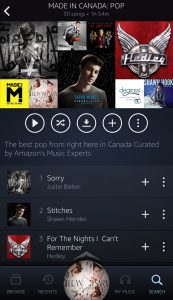
Canadian Amazon Prime customers can now enjoy the company’s on-demand music streaming service Prime Music, which launched today in Canada with over one million songs, hundreds of curated playlists, and personalized stations. The ad-free service is now available to Prime customers at no additional cost to their annual membership.
“Music plays such an important role in our customers’ lives, and we’re excited to provide an even better Prime experience for Canada with the launch of Prime Music,” said Mike Strauch, Country Manager for Amazon Canada.
Prime Music can be accessed through the Amazon Music app on iPads, iPhones, Android devices, laptops or online at www.amazon.ca/primemusic. Mobile listeners can also save music for offline playback on their mobile device when they don’t have an internet connection.
In addition to Prime Music, the Amazon Echo is also now available for pre-order in Canada, which will be made available on December 5, 2017. The voice-activated Dolby speaker system will pair with Amazon Music, Spotify, Radioplayer, TuneIn, and more, providing a seamless, hands-free music experience.
Eligible customers who are not already Prime members can try Prime Music with a 30-day free trial.
Toronto joined an exclusive club made up of 180 cities worldwide last week when the City of Toronto and the Canadian Commission for UNESCO (United Nations Educational, Scientific and Cultural Organization) announced that Toronto has been designated a UNESCO Creative City of Media Arts. While there may not have been much media coverage of the pronouncement, the city’s creative industries ought to be paying attention.
This makes Toronto one of the first cities in Canada to join the network, which was started in 2004 and includes designations for Media Arts, Music, Film, Gastronomy, Literature, Design and Crafts and Folk Art. Toronto’s designation of Media Arts is an attempt to capture the city’s achievements in not one, but several disciplines: “film, music, digital media and forms of cultural expression using technology”.
Few people in Canada may be familiar with UNESCO’s Creative City Network and are perhaps more familiar with its historical site designations or research. This is not a surprise as North America has been relatively slower to join this party. In fact, despite much attention given to Music Cities in North America, including many cities that build their brand on the artform, the first UNESCO City of Music in North America (Kansas City) has only just now been designated.
The international recognition of Toronto’s creative sector efforts is cause for celebration. However, the designation should not be seen as the finish line, but as a springboard for further action. Based on our worldwide scan of Music City strategies, it is clear that the UNESCO designation has the potential of falling into the category of a public relations exercise. But only if we let it.
In some cities, the designation has mobilized a comprehensive program for the promotion, protection and growth of the creative industry for which it is earned. The UNESCO designation has, in other cases, ensured sustained political leadership on creative industry development and investment. The network itself has afforded some cities with practical sharing of knowledge and best practices.
Toronto’s entire music community – including artists and industry – has an opportunity to make sure that the UNESCO designation has meaning. We can leverage the UNESCO designation to secure an ongoing commitment to our music strategy and key priorities like venue sustainability, regulatory red tape reduction, livability for artists and musicians and access to spaces and places for the creation, rehearsal and production of music. We can also use it to reinforce music’s equal standing alongside our partners in film and digital media.
UNESCO’s Creative City Network is definitely what we make it. Let’s take ownership of this opportunity, and prove what we already know: Toronto can be the greatest Music City in the world. We define it, and now we have another tool to help us build it.
UNESCO’s Creative Cities Network promotes cooperation between global cities that place creativity and cultural industries at the heart of their development plans.
In August of 2017, Canada’s Innovation, Science and Economic Development Minister, Navdeep Bains, in conjunction with Mélanie Joly, Minister of Canadian Heritage, announced the launch of consultations on reforming the Copyright Board of Canada. According to the government’s release, the goal of Copyright Board reform is to “enable creators to get paid properly and on time.”
The first letter was submitted on behalf of “Canadian musicians, independent label owners and creative entrepreneurs – at all stages of their careers” 100 of whom added their names. The letter states “While only part of our income comes from royalties collected by collective societies, the rates set by the Board directly impact the value of our music, and our ability to earn a living from it.” The letter specifically supports three options outlined in the consultation’s Discussion Paper and points out that while the role of the Board has evolved, “at the end of the day, the Board is valuing our work, and setting rates that affect our livelihoods.”
The second letter was submitted to Prime Minister Justin Trudeau, and in addition to the list of supporting names, is signed directly by Mulholland, Jim Cuddy, Alan Doyle and Joel Plaskett. It stresses the need for real and meaningful change at the Board, calling for tariffs to be set faster and more in line with market values, and also thanks the government for embarking on the long overdue reform process.
Montreal-based indie rockers Arcade Fire closed the North American leg of Infinite Content tour, which found the band perform in-the-round at more than two dozen arenas across the continent, with two shows last weekend at Toronto’s Air Canada Centre. Prior to the shows, the band were surprised with Platinum award plaques for their fifth studio album, Everything Now, by Sony Music Canada.
Everything Now is the bands fourth Canadian Platinum certification, joining their landmark 2003 debut Funeral, 2010’s Double Platinum album The Suburbs, and 2013’s Triple Platinum two-disc set Reflektor.
The video for the album’s title track can be viewed below.
The City of Ottawa made a significant commitment to the city’s burgeoning Music Strategy today, as Mayor Jim Watson unveiled Ottawa’s Draft Budget 2018 at City Council. The draft budget earmarks $100,000 to support the Ottawa Music Strategy.
The Ottawa Music Strategy was announced last March, and is part of the legacy of Ottawa’s hosting of the 2017 JUNO Awards. The Strategy is being developed by the City of Ottawa and the Ottawa Music Industry Coalition (OMIC), with the goal of making the nation’s capital one of the world’s premier music cities. OMIC has already assembled a group of music industry representatives and local business and community leaders, known as the Ottawa Music Strategy Task Force, to develop a series of practical recommendations for the Strategy.
The announcement was applauded on Twitter by OMIC, Ottawa Councillor Jeff Leiper, and Music Canada Live.
We’re also very happy to hear there will be the financial support needed to follow through on the strategy and grow the local industry! Thank you for your support Mayor @JimWatsonOttawa! https://t.co/5SVLnhGVgl
To help guide the Strategy’s final recommendations, OMIC and the City of Ottawa are seeking public input in a brief, anonymous survey. The Strategy is expected to be presented to City Council in early 2018.
The draft budget will be voted on by City Council on Dec. 13, 2017.
On Monday, November 13, Toronto Music Advisory Council (TMAC) chairs Jeff Cohen (Collective Concerts) and Jesse Kumagai (Live Nation) will moderate an open discussion about the most pressing issues facing live music venues in Toronto, focusing on ongoing venue sustainability and potential revenue growth.
This panel will explore traditional spaces and business models, while a later session will focus on the challenges facing DIY spaces.
In 2016, Toronto City Council unanimously approved TMAC’s Toronto Music Strategy, which aims to guide the short and long-term growth of Toronto’s music sector. Following a public consultation, the music strategy identified six major strategic areas for TMAC and the City of Toronto to focus on for supporting and growing Toronto’s music sector, with many of the key principles from the report expected to be discussed at the November 13 event.
The live music industry forum will run from 4-6pm at Lula Lounge (1585 Dundas St. W), and is open to all live music industry professionals, venue owners and operators, musicians, agents, touring professionals, city councillors and officials. If you are interested in attending the discussion, you can RSVP through the Facebook event or by e-mailing info@lula.ca.
Universal Music Canada staff pose with Niall Horan at Massey Hall
On Wednesday, November 1, pop sensation Niall Horan paid his Toronto die-hards a special visit for an intimate show at Massey Hall in support of his debut solo album, Flicker. Prior to the highly anticipated performance, Horan was surprised with a Gold plaque for the album by Universal Music Canada, which also commemorates his Double Platinum singles “Slow Hands” and “This Town.”
https://www.instagram.com/p/BbAp83NHxRT/
Following the presentation, the former One Direction member went on to perform tracks off his latest album for the excited Toronto crowd, including a cover of the 1D hit “Fool’s Gold.” As a member of the pop group, Horan earned four Canadian Gold Album Award certifications, with Take Me Home and Up All Night both earning Triple Platinum status.
The Irish singer-songwriter will return to Toronto next year for a show at Budweiser Stage on September 5, 2018.
Watch the lyric video for “Slow Hands” from the Gold-certified album Flicker below.










 On Monday, November 13,
Music Canada